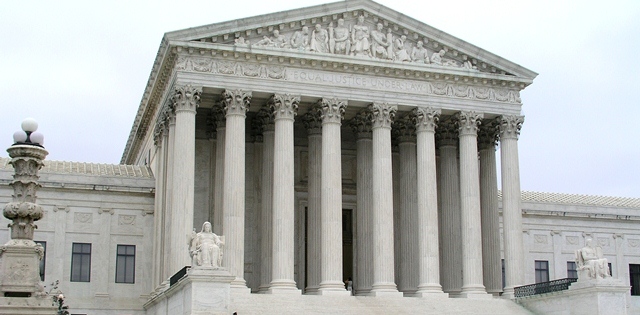
In this case on birthright citizenship there has been no decision authored as of yet. The oral arguments at the Supreme Court took place on 04/01/2026. Below is how the law would be likely interpreted if the U.S. government won, and then if the side representing Barbara won.
Likely legal outcome if the U.S. Government wins on the Birthright Citizenship Case: Meaning Birthright Citizenship would be narrowed. 🇺🇸
If the U.S. government’s position is ultimately accepted, resulting in a narrower interpretation of the Constitution birthright citizenship is upheld, but clarified and somewhat limited to enforce in it limits that are more in line with the original understanding and interpretations of the U.S. Constitution, the Fourteenth Amendment to it, the Civil Rights Act of 1866, 8 U.S. Code § 1401 and the original intentions of its framers.
Under this view, the Supreme Court would agree with the U.S. government that a child must be born in the United States and have a real connection to U.S. jurisdiction, based on the parents’ lawful status or established domicile, to automatically receive citizenship at birth.
This idea comes from the original intent behind the Fourteenth Amendment after the Civil War, which focused on granting citizenship to people fully under U.S. authority, like formerly enslaved individuals. Cases like United States v. Wong Kim Ark are used to support the idea that parental domicile and connection to the U.S. matter in determining jurisdiction and domicile.
Under this reasoning, if parents lack lawful status or a clear legal connection to the U.S. “status”, then their child may not be considered fully within the U.S. jurisdiction at birth. This approach relies on original meaning and historical context, with domicile and parental status playing a key role in deciding who qualifies for birthright citizenship.
It also treats any change in the law as applying only going forward and not retroactively to past cases or individuals.
Likely legal outcome if the ACLU wins on the Birthright Citizenship Case: Meaning Birthright Citizenship in America would stay the same. 🇺🇸
If the ACLU’s position is accepted as the only interpretation of the 14th Amendment to the U.S. Constitution, and preserves the long-standing understanding of birthright citizenship, that depends only on physical presence in the U.S. at the time of birth, as a sole factor to gain U.S. citizenship.
Without adding any new limits based on parental status or domicile, this decision keeps the current rule of birthright citizenship in place. It confirms that citizenship is based on being born in the United States, not on a parent’s immigration status, and leaves broader policy decisions to Congress and other branches.
If the Court reaffirms that the Fourteenth Amendment guarantees citizenship to everyone born in the United States and subject to its jurisdiction, it rejects adding any extra requirements like “domicile” or “lawful status.” This would mean that citizenship applies regardless of the parents’ immigration status, as long as the birth occurs on U.S. soil.
The Court relies on cases like United States v. Wong Kim Ark, which support the idea that being born in the United States is enough to grant citizenship. Under this view, jurisdiction means being physically present and subject to U.S. laws, not the legal status of the parents.
The ruling confirms that birthright citizenship applies equally to all qualifying individuals and cannot be narrowed without action from Congress. It also serves as a clarification of the law going forward while keeping the existing rule intact.
Issues to Consider:
The purpose of the 1866 Civil Rights Act, along with the Fourteenth Amendment to the U.S. Constitution, was to ensure equal legal status for Black Americans after the abolition of slavery, granting them the same rights as white citizens. At the same time, more recent Supreme Court decisions in immigration-related cases show that the Court has often been cautious about expanding rights for noncitizens. For example, in Department of State v. Munoz, the Court held that a U.S. citizen does not have a fundamental right to have a noncitizen spouse admitted into the country. In Johnson v. Arteaga-Martinez, the Court ruled that the government is not required to provide bond hearings with a specific burden of proof for detained noncitizens. Similarly, in Pereida v. Wilkinson, the Court placed the burden on the noncitizen to prove eligibility for relief in immigration proceedings. Together, these decisions reflect how the Court has approached immigration issues while the original purpose of the Fourteenth Amendment focused on securing equal citizenship rights.
What the 1866 Civil Rights Act was designed to do, in conjunction with the 14th Amendment to the U.S. Constitution, was to ensure equal legal status for Black Americans ensuring they had the same rights as white citizens after the abolition of slavery. That was the text’s purpose.
Meanwhile, other immigration cases have not been decided favorably in the U.S. Supreme Court when it comes to citizenship as a right, for example:
The Supreme Court of the United States reversed the Ninth Circuit’s decision in Department of State v. Munoz (2024), holding that a citizen does not have a fundamental liberty interest in her noncitizen spouse being admitted to the country. The Court noted that while Congress has extended special treatment to marriage in immigration matters, it has never made spousal immigration a matter of right.
And pertaining to immigration bond hearings, the Supreme Court found in Johnson v. Arteaga-Martinez (2022) that the U.S. government is not required to provide noncitizens, detained for six months, with bond hearings in which the government bears the burden of proving, by clear and convincing evidence, that a noncitizen poses a flight risk or a danger to the community. Though this is off topic to citizenship, it shows the way the Supreme Court has been ruling as it pertains to immigration type challenges.
See also, Pereida v. Wilkinson (2021), where the Supreme Court found that a non-permanent resident seeking to cancel a lawful removal order has not met the burden of showing that they have not been convicted of a disqualifying offense when the record shows that they have been convicted under a statute listing multiple offenses, some of which are disqualifying, and the record is ambiguous as to which crime formed the basis of the conviction.
https://www.supremecourt.gov/oral_arguments/audio/2025/25-365
https://www.supremecourt.gov/oral_arguments/argument_transcripts/2025/25-365_k536.pdf
https://www.law.cornell.edu/uscode/text/8/1401
https://www.cbp.gov/newsroom/stats/cbp-enforcement-statistics
https://supreme.justia.com/cases-by-topic/immigration-national-security